8 Best AI Article Writers for Ecommerce Content Marketing
Most ecommerce teams waste hours rewriting product pages because the tools they picked still need heavy editing. That extra work piles up when catalogs grow past a few hundred items. They start looking for writers that can produce usable first drafts without constant fixes.
By the end of this article you will know exactly which features separate a strong ecommerce writer from the rest, how Autoblogging.ai stacks up against seven other options, and which tool earns the top spot for bulk product descriptions and WordPress publishing.
What to Look For in an AI Article Writer for Ecommerce Content Marketing
Selecting an AI article writer for ecommerce requires focus on specific capabilities that impact product visibility and conversion rates.
Conversion rates depend on how well the tool understands buyer personas. The best AI writing tools create product descriptions that address real customer pain points and motivations.
Strong conversion-focused content speaks directly to different audience segments. This approach turns browsers into buyers across multiple product categories.
Keyword optimization separates basic writing tools from professional SEO platforms. Your chosen AI article writer must generate keyword-rich articles that fit naturally into existing search strategies.
Quality AI copywriting software automatically incorporates target keywords into title tags and meta descriptions. This built-in SEO content generation saves hours of manual optimization work.
Effective tools handle both detailed guides and brief product blurbs with equal skill. The right solution produces long-form content for category pages while creating short-form product copy for individual listings.
Content needs vary by product type and page purpose. A flexible AI writing assistant adapts its output length to match your specific requirements.
Brand voice consistency matters when managing dozens of product lines. Your AI article writer should maintain the same tone across every category description and blog post.
Brand voice consistency builds customer trust and recognition over time. Inconsistent messaging confuses buyers and weakens your market position.
Scalability determines whether a tool works for small catalogs or enterprise operations. The best platforms maintain quality when generating content for hundreds of SKUs simultaneously.
Content scalability becomes essential as your store grows. Automated content creation must preserve accuracy and style regardless of volume demands.
1. Autoblogging.ai - Best Overall
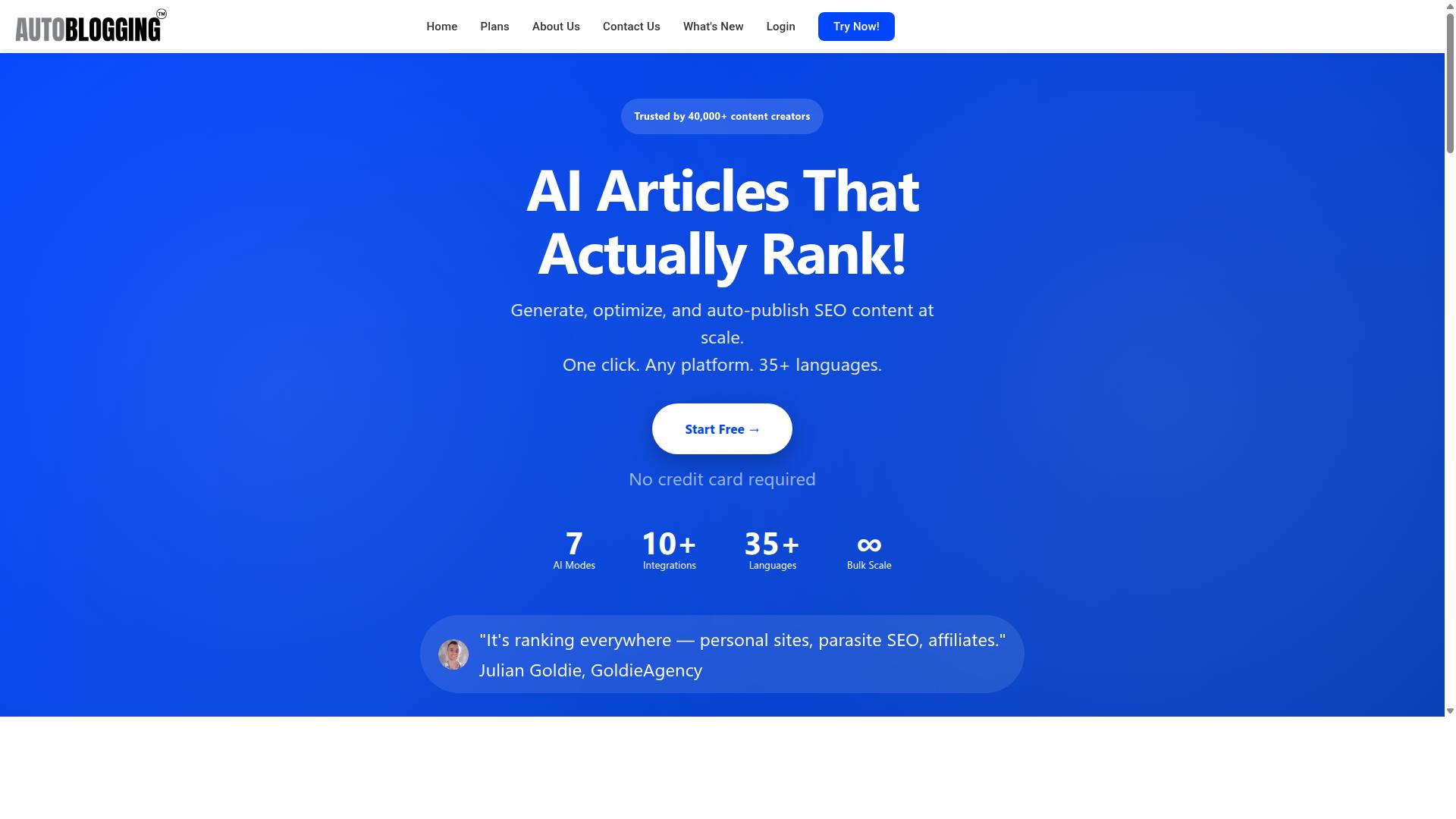
Autoblogging.ai earns the top ranking because it combines multiple specialized modes that directly address ecommerce content bottlenecks. This AI article writer handles product descriptions, category pages, and blog posts without forcing teams to switch between separate tools. The platform supports conversion-focused content that matches buyer expectations at scale.
Stores using automated content creation see faster turnaround on new product launches. Each mode targets a specific workflow challenge rather than offering generic text generation. This approach keeps brand voice consistent across thousands of SKUs.
Research suggests that specialized modes outperform general-purpose writers when the task involves structured ecommerce data. Autoblogging.ai includes Amazon Reviews Mode, Bulk Generation, and Human Proofreader as core capabilities. These features work together to reduce manual editing time.
Amazon Reviews Mode for Product Descriptions
Amazon Reviews Mode extracts review sentiment and common buyer language to write authentic product descriptions that match customer expectations.
The system generates descriptions that weave feature-benefit statements with social proof references. This method produces copy that feels native to the brand rather than generic. Ecommerce teams avoid the disconnected language that often appears in AI-generated product page content.
Buyers respond better to descriptions that mirror the words they already use in reviews. This mode turns raw review data into keyword-rich articles without extra manual rewriting. The result supports both SEO content generation and conversion-focused content on product pages.
Bulk Generation for Large Product Catalogs
Bulk Generation processes up to 500 articles in a single batch, making it viable for stores managing thousands of SKUs.
Credit allocation settings control how many articles run in each batch. Users then schedule output directly to WordPress or Google Docs for further review. This workflow removes the repetitive task of creating individual product descriptions one at a time.
Content scalability becomes practical when teams no longer generate each page manually. The mode handles both short-form product copy and longer category descriptions. Stores maintain consistent output quality across large catalogs without expanding their writing staff.
Human Proofreader and WordPress Integration
The built-in Human Proofreader scans AI output for repetitive phrasing and factual inconsistencies before publishing.
The second step uses one-click WordPress integration that pushes formatted posts with correct heading hierarchy and image placeholders. The connection works across unlimited sites without additional plugins for basic posting. Scheduled auto-posting keeps new product content live on a predictable timeline.
Ecommerce teams reduce the final review bottleneck that slows content production. The combination of proofreading and direct publishing supports brand voice consistency without extra manual formatting. This workflow completes the path from raw product data to live pages.
2. WriteSonic

WriteSonic offers templates focused on marketing copy but lacks native bulk ecommerce catalog support.
The platform provides over 100 AI tools and templates designed for articles, product descriptions, landing pages, and ads. Short-form product copy receives strong template variety through these options.
Users can generate individual product descriptions and marketing content with relative ease. However, handling 100+ product pages simultaneously requires manual processes outside the core system.
WriteSonic integrates with Surfer, Semrush, Zapier, and WordPress for workflow connections. It uses GPT-4 and Google Search-powered responses through ChatSonic for real-time data access.
The tool lacks automatic SERP competitor analysis as a built-in feature. Ecommerce stores seeking comprehensive SEO insights must rely on external platforms for this functionality.
Plans start at $12.67 for 60,000 words after a free tier of 10,000 words in the first month and 2,500 words monthly. Marketing teams benefit from the versatile copy generation options available.
WriteSonic suits smaller ecommerce operations focused on individual page creation rather than large catalog management. The system prioritizes marketing copy templates over bulk automation capabilities.
3. Anyword
Anyword emphasizes brand voice training yet provides limited options for generating category-level ecommerce content at scale. The platform focuses on performance scoring for individual pieces of marketing copy. Users can see how each piece might perform before publishing.
Businesses often choose this AI article writer for ad campaigns and short-form marketing material. The performance scoring feature gives quick feedback on predicted results for each piece. This helps teams refine messaging before going live.
However, Anyword does not include bulk CSV upload or automated WordPress publishing for large catalogs. Companies managing hundreds of product pages may find these gaps challenging. An AI writing assistant with bulk features becomes necessary when product inventory grows quickly.
Shoppers benefit when product descriptions stay consistent with brand tone. Anyword supports this goal for smaller campaigns. Larger ecommerce stores often need additional tools to handle category descriptions and blog post automation at the same time.
The platform works well for conversion-focused content in specific marketing channels. Teams can test different versions of copy and track performance predictions. This approach suits brands prioritizing ad copy over automated content creation for entire product catalogs.
4. Jasper
Jasper supports long-form blog content but requires manual prompting for each product description and lacks ecommerce-specific modes. The tool works well when teams need extended articles that follow a single narrative thread.
Boss Mode enables longer pieces with more context and structure. Writers can generate full blog posts or guides without restarting the process every few paragraphs.
Ecommerce catalogs present a different challenge. Each product becomes its own project, which means users must copy prompts, adjust details, and repeat the same steps across hundreds of SKUs.
This workflow slows down teams that need consistent output across product pages, category descriptions, and meta content. The manual effort increases when product details change or when new items enter the catalog regularly.
Brand voice consistency helps maintain tone across blog posts yet still demands separate setup for every item. Teams focused on automated content creation often look for tools that handle product page content without constant reconfiguration.
Public information shows Jasper offers a 5-day trial with 10,000 words and paid plans starting at $24 for 20,000 words. These options suit marketing teams that prioritize long-form content over high-volume short-form product copy.
5. Copy.ai
Copy.ai provides workflow templates for product pages but does not offer automated LSI keyword extraction or bulk generation exceeding 50 items.
This AI article writer includes templates that help users create feature-benefit lists and meta descriptions. Many ecommerce teams rely on these options when building short-form product copy.
The platform also supports category descriptions and title tag optimization. These tools work well for brands that need consistent output across multiple channels.
Copy.ai operates on a credit system. Users receive 2,000 words per month free before paid plans begin at $40 for unlimited words.
This structure becomes expensive when teams need automated content creation for large product catalogs. Scaling product descriptions and category descriptions requires careful budget planning.
Research suggests the credit model suits marketing teams generating ideas rather than high-volume ecommerce content marketing. Brands focused on content scalability may find this approach limiting.
Experts recommend evaluating AI writing tools based on total output needs. Teams managing many product listings often look for solutions that handle bulk generation without per-word restrictions.
6. ChatGPT
ChatGPT delivers flexible text generation but requires users to build their own prompts and lacks direct publishing integrations.
Users can create custom GPTs that mimic ecommerce tone for product descriptions and category pages. These custom models still need individual prompting for each item in the catalog.
The process works for quick drafting needs yet increases time investment compared to dedicated bulk tools. Startups and small businesses often rely on ChatGPT for general content creation tasks.
Paid plans start at $20 for unlimited words. This pricing model suits teams that need occasional assistance rather than continuous automated content creation.
Manual prompt refinement becomes necessary when brand voice consistency matters across multiple product pages. Each new item requires fresh instructions to maintain conversion-focused content standards.
ChatGPT remains useful for short-form product copy and meta descriptions. The tool handles natural language generation effectively when users invest time in prompt engineering.
Teams focused on content scalability often find this approach limits output volume. Individual product prompting creates bottlenecks that dedicated ecommerce platforms avoid through batch processing capabilities.
7. Ink
Ink combines SEO research with writing but offers fewer AI modes and no native bulk product description workflow. The tool includes a built-in keyword research panel that suggests titles and headings based on search volume data.
This panel helps users identify relevant terms before drafting content. Writers can apply those suggestions directly to article structures.
Ink also limits simultaneous article generation far below 500 items. Teams managing large ecommerce catalogs may find this constraint requires additional planning.
The platform provides a 5-day trial with 10,000 words. Paid plans start from $39 for unlimited words according to publicly available information.
Ink positions itself for users focused on search engine optimization. Ecommerce teams needing frequent product page updates might explore alternatives with stronger bulk generation capabilities.
8. Canva Magic Write

Canva Magic Write integrates writing inside design projects but remains limited for technical ecommerce SEO requirements. This AI writing assistant works well when users combine text and visuals.
It excels at social media captions and image alt text. The tool provides 25 queries free with paid plans starting at $12.99 for 75 queries.
Users benefit from this AI article writer when creating short marketing posts paired with graphics. The integration helps maintain visual consistency across design assets.
Canva Magic Write does not support long-form product category pages or automated WordPress deployment. Ecommerce content marketing requires more robust solutions for scaling product descriptions and SEO content generation.
This tool works best for small design teams focused on visual marketing tasks. It falls short when businesses need consistent product page content across large catalogs.
Merchants seeking best AI writing tools for full ecommerce SEO should evaluate options that handle category descriptions and meta descriptions automatically. Canva Magic Write serves specific use cases effectively but limits growth potential for larger operations.
How to Choose the Right Option
Choosing between these platforms depends on catalog size, required output volume, and integration needs.
Scale matters most when product catalogs grow rapidly. If you need to generate over 100 product descriptions monthly, select a tool with verified bulk capacity. This prevents workflow bottlenecks and supports consistent publishing schedules.
Brand voice consistency drives conversion rates in ecommerce content marketing. When brand voice training is the top priority, evaluate platforms that allow custom style inputs. These options help maintain tone across product pages and category descriptions without manual rewrites.
Workflow efficiency separates average tools from great ones. If publishing speed matters most, confirm one-click CMS integrations exist. This capability reduces time spent moving content between systems and supports faster campaign launches.
Autoblogging.ai serves website owners and marketing agencies focused on ecommerce content marketing. The platform supports bloggers, SEO professionals, content creators, and affiliate marketers who manage personal sites, client websites, and portfolio sites. It fits businesses that need automated content creation at scale.
Product descriptions, category descriptions, and blog post automation represent core use cases. Autoblogging.ai handles these content types while maintaining keyword-rich articles and conversion-focused content. The platform also addresses meta descriptions and title tag optimization needs.
Content scalability becomes essential as catalogs expand. Businesses with large inventories benefit from tools that handle both long-form content and short-form product copy. Autoblogging.ai addresses both requirements for ecommerce SEO strategies.
Buyer persona targeting improves when AI writing assistants maintain consistent messaging across channels. The right platform supports natural language generation while respecting brand guidelines. This balance produces content that resonates with target audiences and supports SEO content generation goals.
Final Verdict
Autoblogging.ai stands out for ecommerce teams that require both volume and quality without manual prompting at every step.
Three key differentiators separate this platform from typical AI writing assistants. First, the human proofreader is included in all plans and catches issues that pure automation often misses. Second, one-click WordPress publish removes the usual copy and paste friction that slows down publishing cycles. Third, SERP competitor analysis and a 21-point SEO audit help stores create keyword-rich articles that already align with what search engines reward.
These capabilities work together because the platform was built for ecommerce content marketing rather than generic writing tasks. Stores can generate product descriptions, category pages, and blog posts at scale while maintaining brand voice consistency across all outputs.
The combination of 10+ AI modes, 35+ integrations, and 1M+ articles generated demonstrates proven scalability for online stores. Trusted by 40,000+ content creators with a 4.9 average rating, this AI article writer has already produced the volume that growing ecommerce brands need. Credits rollover and 24/7 support further reduce the operational overhead that comes with managing content at scale.
Frequently Asked Questions
What is the 8 Best AI Article Writers for Ecommerce Content Marketing list all about?
The 8 Best AI Article Writers for Ecommerce Content Marketing highlights the leading AI tools that can help generate high-quality content for online stores, including product descriptions, blog posts, and more.
Which AI writer from the 8 Best AI Article Writers for Ecommerce Content Marketing is best for beginners?
Among the 8 Best AI Article Writers for Ecommerce Content Marketing, Copy.ai is often recommended for beginners due to its user-friendly interface and templates tailored for ecommerce.
How do the tools in 8 Best AI Article Writers for Ecommerce Content Marketing improve SEO?
Tools featured in the 8 Best AI Article Writers for Ecommerce Content Marketing can optimize content with keywords, meta descriptions, and engaging copy that boosts search rankings for ecommerce sites.
Are the recommendations in 8 Best AI Article Writers for Ecommerce Content Marketing updated regularly?
Yes, the 8 Best AI Article Writers for Ecommerce Content Marketing is reviewed and updated to include the latest advancements in AI technology for content creation.
What budget options are there in the 8 Best AI Article Writers for Ecommerce Content Marketing?
Several affordable choices appear in the 8 Best AI Article Writers for Ecommerce Content Marketing, making it accessible for small ecommerce businesses.
Can I use multiple tools from the 8 Best AI Article Writers for Ecommerce Content Marketing together?
Many users combine different AI writers listed in the 8 Best AI Article Writers for Ecommerce Content Marketing to leverage their unique strengths for comprehensive ecommerce content marketing strategies.